

Panduan trading
Apa Leverage dalam Forex? Cara Menggunakannya Tanpa Menghancurkan Akun Anda
Leverage forex menjelaskan: bagaimana ia melipatgandakan keuntungan dan kerugian, seperti apa margin call, tingkat leverage yang paling aman, dan kerangka kerja praktis untuk menggunakan leverage 1:3000 tanpa meledak.

Anda dapat mengontrol posisi $100.000 dengan $500 di akun Anda, itulah janji leverage, dan ini juga merupakan cara tercepat menuju nol jika Anda tidak memahami mekanisme di baliknya. Artikel ini menguraikan apa itu leverage di forex, bagaimana leverage melipatgandakan keuntungan dan kerugian, dan bagaimana memilih pengaturan leverage yang membuat Anda bertahan dalam permainan cukup lama untuk menambah kemenangan kecil. Pada akhirnya Anda akan memiliki kerangka kerja berbasis angka yang jelas untuk menggunakan leverage dan margin tanpa memperlakukan akun Anda seperti tiket lotre.
TL;DR. Leverage memungkinkan Anda mengontrol posisi forex yang lebih besar dari saldo akun Anda. Rasio ritel umumnya berkisar dari 1:30 (UE/Inggris) hingga 1:3000 (luar negeri). Pergerakan merugikan sebesar 1% pada 1:100 menghabiskan sekitar 50% margin Anda; langkah yang sama pada 1:3000 menghapus akun. Pengaturan yang tepat ditentukan oleh aturan risiko per perdagangan Anda (1–2% ekuitas), bukan rasio maksimum broker. Panduan ini menguraikan mekanisme, urutan margin-call yang tepat, dan formula ukuran 30 detik yang dapat Anda terapkan pada perdagangan apa pun.
Apa Itu Leverage dalam Forex, Definisi Satu Kalimat yang Sebenarnya Ada
Broker Andalah yang meminjamkan modal sehingga Anda dapat membuka posisi yang jauh lebih besar daripada uang tunai yang ada di akun Anda. Satu kalimat itu menghilangkan kebingungan, yang lainnya hanyalah matematika yang mengikutinya.
Rasio yang Menggandakan Daya Beli Anda
Modal pinjaman ini dinyatakan sebagai rasio: angka pertama adalah total ukuran posisi yang dapat Anda kendalikan oleh broker, dan angka kedua adalah deposit aktual Anda (margin).
Rasio 1:30 berarti untuk setiap $1 uang Anda, broker menyetor $29. Pada akun $1.000 dengan leverage 1:30, Anda dapat membuka posisi senilai $30.000. Pada 1:100, $1.000 yang sama mengontrol $100.000, satu lot standar dalam EUR/USD.
Rasio umum yang akan Anda lihat di platform broker:
1:10, konservatif, sebagian besar pada pasangan eksotik atau di bawah regulator tertentu
1:30, ESMA batas ritel untuk pasangan mata uang utama di Eropa
1:100, standar industri untuk sebagian besar broker luar negeri
1:500, agresif, umum di antara broker internasional
1:3000, sangat tinggi; satu pergerakan pip dapat menghapus sebagian besar akun Anda
Leverage Tidak Mengubah Nilai Pip, Ini Mengubah Biaya Pip Anda
Satu pip pada lot standar EUR/USD (100.000 unit) selalu $10. Rasio tidak mengubah hal itu. Perubahan leverage adalah berapa banyak dari akun Anda $1.000 yang diwakili oleh $10 pip.
Jalankan angka-angka dengan perdagangan EUR/USD nyata pada 1,1000:
Tanpa leverage, Anda membeli euro senilai $1.000. Satu pip bernilai sekitar $0,01. Pergerakan 50 pip mendapat keuntungan atau kerugian $0,50.
leverage 1:30, Anda mengontrol $30.000. Satu pip bernilai $3. Pergerakan 50 pip mengubah akun Anda sebesar $150 (15% dari deposit Anda).
leverage 1:100, Anda mengontrol $100.000 (satu lot standar). Satu pip bernilai $10. Pergerakan 50 pip adalah $500, separuh akun Anda hilang atau diperoleh dalam satu sesi.
Instrumennya tidak berubah. Nilai pip tidak berubah. Hanya rasio antara modal dan ukuran posisi yang berubah, dan di situlah peluang dan risiko berada.
Bagaimana Leverage Menggandakan Keuntungan dan Kerugian? Simetri yang Harus Dihormati Setiap Trader
Ini adalah pengganda, dan tidak membeda-bedakan. Pergerakan 1% terhadap posisi Anda menghancurkan persentase margin yang sama persis dengan perolehan 1% pergerakan menguntungkan. Perhitungannya benar-benar simetris, dan mengabaikan simetri tersebut adalah cara tercepat untuk menghancurkan akun.
Contoh Pekerjaan 1:100
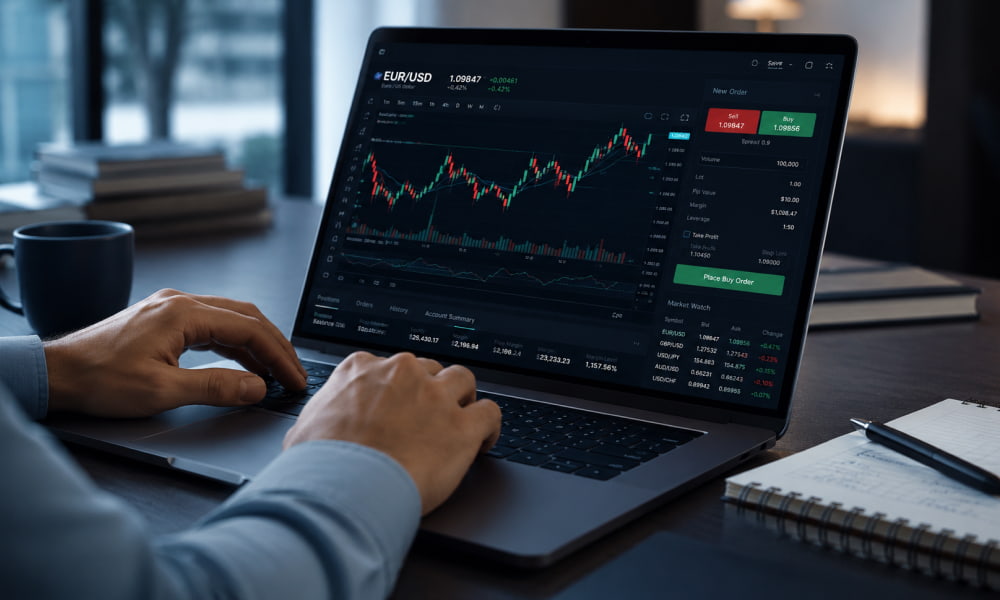
Anda menyetor $500 dan membuka posisi EUR/USD menggunakan leverage 1:100. Eksposur nosional Anda adalah $50.000, setengah lot standar. EUR/USD bergerak 50 pip, kira-kira 0,5% dari nilai pasangan.
Skenario keuntungan: 50 pip × $5 per pip (nilai setengah lot) = keuntungan $250. Itu adalah pengembalian 50% dari margin $500 Anda.
Skenario kerugian: 50 pip yang sama, $5 per pip yang sama = kerugian $250. Akun Anda turun menjadi $250, penarikan sebesar 50%.
Naikkan menjadi pergerakan 1% penuh (kira-kira 100 pip pada EUR/USD) dan angkanya menjadi nyata: keuntungan 100% pada margin Anda atau penghapusan total. Penelitian BIS pada aliran FX ritel secara konsisten menemukan bahwa rata-rata akun ritel kehilangan uang selama jangka waktu 12 bulan, simetri leverage memotong keunggulan ritel pada umumnya, bukan karena itu. Leverage memperkuat kedua arah pada tingkat yang sama. Tidak ada asimetri, tidak ada bantalan, tidak ada "leverage bekerja lebih keras bagi pemenang."
Mengapa "% Akun Berisiko Per Pip" Lebih Penting Daripada Rasio
Sebagian besar trader terpaku pada rasio, 1:30, 1:100, 1:500, namun angka tersebut hampir tidak memberi tahu Anda apa pun tentang risiko Anda yang sebenarnya. Metrik yang penting adalah persentase akun berisiko per pip.
Hitung: (nilai pip dalam dolar ÷ saldo akun) × 100. Jika akun Anda $500 dan nilai pip Anda $5, setiap pip memindahkan akun Anda sebesar 1%. Stop-loss 50 pip berarti Anda mempertaruhkan 50% akun Anda dalam satu perdagangan. Itu adalah angka sebenarnya yang harus diperhatikan, bukan rasio pada tiket.
1:10 vs 1:500, Eksposur Dolar Riil
Dua pedagang masing-masing memiliki akun $5.000 dan keduanya membeli EUR/USD pada harga 1,1000.
Pedagang A (1:10): Mengontrol $50.000 (setengah banyak). Nilai pip ≈ $5. Kerugian 100 pip merugikan $500, 10% dari akun.
Trader B (1:500): Mengontrol $2,500,000 (25 lot standar). Nilai pip ≈ $250. Kerugian sebesar 100 pip memerlukan biaya $25.000, lima kali lipat dari seluruh saldo akun.
Keduanya menggunakan "leverage", namun Trader B memiliki leverage 50 kali lebih banyak dalam dolar. Rasio tersebut saja tidak menyebabkan ledakan; ukuran posisi yang diaktifkannya demikian. Kelola ukuran posisi dengan mengontrol persentase akun Anda yang berisiko per pip, dan rasio menjadi perhatian kedua.
Leverage dan Margin: Dua Angka yang Harus Anda Lacak Sebelum Setiap Perdagangan
Leverage memungkinkan Anda mengontrol posisi yang lebih besar, namun margin adalah uang tunai aktual yang harus Anda berikan sebagai jaminan untuk membuka dan mempertahankan posisi tersebut. Setiap perdagangan menghabiskan sebagian dari saldo Anda, dan ketika bagian tersebut habis, broker menutup perdagangan Anda untuk Anda.
Cara Menghitung Margin
Margin bukanlah biaya. Ini adalah uang jaminan yang dikembalikan saat Anda menutup perdagangan. Rumusnya sangat mudah:
(Ukuran lot × Ukuran kontrak) Leverage = Margin yang dibutuhkan
Contoh: Lot standar (100.000 unit) EUR/USD dengan leverage 30:1.
Nilai posisi: 100.000 EUR
Bagi dengan 30: 100.000 30 = $3.333,33
$3.333 itu adalah margin yang Anda gunakan, terkunci dalam perdagangan, tidak tersedia untuk hal lain.
Turunkan leverage menjadi 10:1 dan lot yang sama akan berharga margin $10.000. Naikkan menjadi 100:1 dan biayanya $1.000. Leverage yang lebih tinggi berarti lebih sedikit jaminan per perdagangan, namun juga lebih sedikit ruang untuk kesalahan.
Empat Angka di Terminal Anda
Setiap platform MT4/MT5 menampilkan empat bidang terkait margin. Inilah yang dimaksud dengan akun $10.000 pada 30:1, satu perdagangan terbuka menggunakan margin $3.333:
Nilai Bidang Apa Artinya Ekuitas Akun Saldo $10.000 + P&L mengambang (turun jika perdagangan berlawanan dengan Anda) Margin yang Digunakan $3.333 Jaminan yang dikunci oleh posisi terbuka Margin Bebas $6,667 Ekuitas dikurangi margin yang digunakan, tersedia untuk perdagangan baru Tingkat Margin 300% (Ekuitas ÷ Margin yang digunakan) × 100
Apa yang Terjadi Ketika Tingkat Margin Turun Di Bawah 100%
Tingkat margin 100% berarti ekuitas Anda sama persis dengan margin yang digunakan, tidak ada margin bebas yang tersisa. Turun ke bawah batas tersebut dan manajemen risiko broker akan mulai berlaku. Sebagian besar broker mengeluarkan margin call (pemberitahuan) dan kemudian, ketika levelnya turun ke ambang batas yang telah ditentukan (seringkali 50% atau 80%), mulai likuidasi, yang secara otomatis menutup posisi dimulai dari perusahaan yang merugi terbesar untuk mengembalikan tingkat margin ke atas ambang batas.
Anda tidak perlu bernegosiasi. Sistem broker melakukannya dalam hitungan detik. Itulah sebabnya melacak margin bebas, yaitu uang tunai yang tersisa untuk menutupi kerugian, lebih penting daripada memantau P&L mengambang Anda secara terpisah.

Apa itu Margin Call? Urutan Peristiwa yang Tepat Saat Perdagangan Bergerak Melawan Anda
Margin call adalah permintaan formal broker atas dana tambahan ketika ekuitas akun Anda turun di bawah margin yang diperlukan untuk mempertahankan posisi tetap terbuka. Ini bukan sebuah saran, ini adalah ambang batas. Jika Anda gagal mengambil tindakan, broker akan menutup perdagangan Anda.
Berikut adalah urutan yang tepat, langkah demi langkah.
Langkah 1: Kerugian Mengambang Menghancurkan Ekuitas
Anda membuka posisi dan pasar bergerak melawan Anda. Ekuitas Anda (saldo plus atau minus P&L mengambang) menyusut secara real time. Persyaratan margin tetap, berdasarkan ukuran posisi, bukan harga saat ini. Saat ekuitas turun, tingkat margin Anda (ekuitas ± margin yang digunakan × 100) turun.
Langkah 2: Tingkat Margin Mencapai Ambang Peringatan
Sebagian besar broker mengeluarkan peringatan margin-call ketika tingkat margin mencapai 100%. Pada titik ini ekuitas Anda sama dengan margin yang digunakan, Anda tidak memiliki margin bebas tersisa. Anda tidak dapat membuka posisi baru. Anda akan melihat peringatan berwarna merah di terminal MT4/MT5. Ini adalah peringatan, bukan likuidasi. Anda masih dapat menahan perdagangan jika Anda menambahkan dana atau pasar berbalik arah.
Langkah 3: Stop-Out, Likuidasi Aktual
Jika pasar terus bergerak berlawanan dengan Anda dan tingkat margin semakin turun, broker mencapai tingkat stop-out. Ini adalah titik di mana broker secara otomatis menutup posisi terlemah Anda (kerugian terbesar, atau yang memakan margin paling banyak) untuk mencegah akun menjadi negatif. Ambang batas umum: tingkat margin 50% atau 20%, bergantung pada broker dan instrumen.
Skenario Konkrit: $1.000 pada 1:100 di EUR/USD
Akun: Ekuitas $1.000, 1:100 leverage
Posisi: 0,1 lot standar (10.000 unit) EUR/USD, memerlukan margin $100
Tingkat margin saat pembukaan: 1.000 100 × 100 = 1.000%
EUR/USD bergerak 80 pips melawan Anda: kerugian mengambang = $80
Ekuitas: $1.000 − $80 = $920
Tingkat margin: $920 − $100 × 100 = 920%, masih aman
Bahaya sebenarnya datang dari posisi yang lebih besar. Lot standar 1,0 pada akun $1.000 yang sama memerlukan margin $1.000. Pergerakan 50 pip yang merugikan Anda akan menurunkan ekuitas menjadi $500 dan tingkat margin menjadi 50%, tepat pada stop-out. Satu pip lagi dan broker melikuidasi. Perbedaan antara akun peringatan dan akun yang rusak seringkali hanya beberapa pip buffer.
Leverage 1:3000, Saat Rasio Ekstrim Masuk Akal dan Saat Menjadi Jebakan
Apa Arti Sebenarnya 1:3000 dalam Dolar
Pada leverage 1:3000, margin $1 mengontrol posisi $3.000. Akun $100 dapat membuka posisi lot standar 0,3, nosional $30.000, dengan hanya $10 yang diikat sebagai margin. Sisa $90 ditempatkan sebagai margin bebas, namun buffer tersebut menghilang dengan cepat.
Untuk memasukkannya ke dalam istilah pip: pada lot standar (100.000 unit), setiap pip di EUR/USD bernilai $10. Pada 1:3000, pergerakan 10 pip terhadap Anda pada posisi 0,1 lot menghasilkan kerugian $10, 10% dari akun $100.
Satu-Satunya Kasus Penggunaan Rasional
Leverage ekstrem masuk akal dalam satu skenario: akun sangat kecil yang digunakan dengan stop sangat ketat. Jika Anda memperdagangkan akun $50–$200 dan strategi Anda menargetkan pergerakan 2–5 pip dengan penghentian keras pada 3–5 pip, 1:3000 memungkinkan Anda menempatkan posisi lot mikro yang berarti yang tidak mungkin dilakukan.
Di luar kisaran sempit tersebut, rasionya adalah sebuah liabilitas. Sebagian besar trader ritel tidak dapat melakukan eksekusi secara konsisten dalam stop 3 pip pada feed spread variabel langsung.
Soal Matematika 3-Pip
Pada 1:3000 pada lot mikro (0,01 lot standar), setiap pip bernilai $0,10 pada EUR/USD. Pergerakan merugikan 3 pip dikenakan biaya $0,30. Pada akun $100, itu adalah 0,3%, dapat bertahan. Namun tingkatkan ke lot mini (0,10) dan 3 pip yang sama berharga $3,00, 3% akun hilang dalam hitungan detik. Pada lot standar penuh, 3 pip = $30 = 30% dari akun $100.
Rasio leverage itu sendiri tidak menyebabkan kerugian, namun memperbesar ukuran posisi, yang kemudian memperbesar nilai pip. Semakin kecil akun Anda, semakin cepat persentase kerusakan bertambah.
Pemeriksaan Realita Peraturan
ESMA membatasi leverage ritel sebesar 1:30 untuk pasangan mata uang utama. FCA, ASIC, dan MAS menerapkan batasan serupa antara pukul 1:20 dan 1:50. Broker yang menawarkan 1:3000 atau 1:5000 biasanya adalah entitas luar negeri yang terdaftar di yurisdiksi St. Vincent, Seychelles, atau Vanuatu, tanpa batas leverage dan perlindungan investor terbatas. Jika broker bangkrut, tidak ada skema kompensasi untuk memulihkan saldo Anda.
Jika Anda melakukan perdagangan dengan rasio ini, tabel tingkat spesifik broker sama pentingnya dengan nomor judul. tabel leverage OnFin, misalnya, berlaku 1:3000 hanya pada akun dengan ekuitas di bawah $1.000, batasnya diturunkan menjadi 1:500 di atas $5.000 dan menjadi 1:50 di atas $100.000. Leverage valas juga turun menjadi 1:500 dari satu jam sebelum penutupan hari Jumat hingga pembukaan hari Senin sebagai ukuran risiko akhir pekan. Batasan per instrumen juga berbeda: logam dan indeks berada pada 1:100, saham AS pada 1:10. Bacalah tabel tingkatan sebelum menentukan ukuran, angka yang disebutkan di beranda jarang sekali merupakan angka yang sebenarnya Anda perdagangkan.
Aturan Praktis
Tetapkan leverage maksimum Anda dengan rumus ini:
Leverage aman maksimum = (saldo akun × kerugian yang dapat diterima%) (jarak stop dalam pip × nilai pip per lot)
Sederhana: rasio efektif Anda tidak boleh melebihi jumlah pip yang mampu Anda kehilangan dibagi dengan jarak berhenti Anda. Jika Anda mampu kehilangan 30 pips dan stop Anda berjarak 10 pips, 1:3 adalah batas atas Anda, bukan 1:3000. Terapkan rasio tersebut pada saldo Anda yang sebenarnya, bukan saldo impian Anda.
Tingkat Leverage Teraman berdasarkan Ukuran Akun dan Gaya Perdagangan
"Leverage teraman" tidak berarti angka terendah yang ditawarkan broker Anda. Ini berarti rasio yang menjaga penarikan maksimum Anda, penurunan puncak hingga terendah di akun Anda, di bawah 20% dari saldo awal Anda. Penarikan 20% dapat dipulihkan; penarikan 50% biasanya bukannya tanpa risiko berlipat ganda. Tabel di bawah memetakan rentang aman berdasarkan gaya, dengan asumsi jarak stop-loss yang wajar dan ukuran posisi yang sesuai dengan ekuitas akun.
Rasio Efektif berdasarkan Gaya Perdagangan
Gaya Perdagangan Rentang Leverage Aman Tipikal Jarak Stop Scalper 1:10 – 1:30 5–10 pips Day Trader 1:20 – 1:50 15–30 pips Swing Trader 1:10 – 1:20 50–150 pip
Scalper dapat condong sedikit lebih tinggi karena stopnya ketat, kerugian 10 pip pada leverage 1:30 pada lot mikro berharga sekitar $3. Swing trader membutuhkan stop yang lebih luas, jadi leverage yang lebih rendah akan mencegah satu pergerakan merugikan yang mengambil 10% dari akun. Pedagang harian duduk di tengah.
Ukuran Akun Mengubah Matematika
Akun senilai $200 yang mencoba memperdagangkan lot standar (100.000 unit) membutuhkan leverage 1:100 atau 1:200 hanya untuk membuka posisi. Itu tidak membuatnya aman, artinya akun tersebut kekurangan modal untuk ukuran lot. Akun $10.000 yang memperdagangkan lot standar yang sama pada 1:30 menggunakan margin $3.333 dan menyisakan $6.667 sebagai bantalan. Akun $200 yang sama pada 1:100 menggunakan margin $2.000, seluruh akun, sehingga tidak ada ruang untuk satu pip pergerakan merugikan. Aturannya: akun yang lebih besar harus menggunakan leverage lebih sedikit, bukan lebih banyak.
Pengukuran Posisi Adalah Pengendalian Risiko Yang Sebenarnya
Rasio hanyalah pengganda. Alat risiko sebenarnya adalah ukuran posisi, berapa banyak unit yang Anda pasang per perdagangan. Seorang trader yang menggunakan leverage 1:10 pada lot mikro 0,01 berisiko lebih kecil per pipnya dibandingkan trader yang menggunakan leverage 1:5 pada lot standar penuh. Hitung risiko dolar Anda per perdagangan terlebih dahulu (1–2% dari akun), lalu pilih ukuran lot yang sesuai, lalu gunakan leverage yang cukup untuk memenuhi persyaratan margin. Jika leverage yang dibutuhkan melebihi 1:30, posisi tersebut terlalu besar untuk akun tersebut.
Mulai Rendah, Tetap Rendah
Trader baru harus memulai pada 1:10 atau 1:20, apa pun yang ditawarkan broker. Banyak broker menampilkan 1:500 atau 1:1000 sebagai nilai jual. Abaikan saja. Pada 1:10, kerugian 100 pip pada lot mini berharga $10. Pada 1:500, kerugian yang sama bernilai $50, dan tekanan psikologis untuk menutup lebih awal atau menghentikan pergerakan jauh lebih tinggi. Raih keuntungan konsisten selama enam bulan dengan leverage rendah sebelum mempertimbangkan peningkatan.
Tiga Aturan Menggunakan Leverage Tanpa Menghancurkan Akun Anda
Rasio yang tinggi tidak akan menghancurkan akun dengan sendirinya, trader akan menghancurkan akun dengan mengabaikan ukuran posisi, nilai pip, dan leverage efektif mereka sendiri. Ketiga aturan ini membuat Anda tetap berada di sisi kanan dalam perhitungan risiko.
Aturan 1: Risiko 1–2% dari Akun Per Perdagangan, Periode
Rasio leverage Anda tidak relevan dengan aturan ini. Baik broker Anda menawarkan 1:30 atau 1:500, kerugian maksimum yang harus Anda tanggung dalam satu perdagangan adalah 1–2% dari ekuitas akun Anda. Ini adalah batasan yang sulit, bukan saran.
Contoh: Akun $5.000 berarti kerugian maksimum $50–$100 per perdagangan. Jika lebar stop-loss Anda adalah 20 pip pada EUR/USD, Anda menghitung ukuran posisi yang menjaga kerugian tetap dalam kisaran $50–$100, berapa pun besar leverage yang diperbolehkan broker Anda. Aturan ini saja menghilangkan kemungkinan satu perdagangan menghapuskan Anda.
Aturan 2: Ketahui Nilai Pip dalam Mata Uang Akun Anda Sebelum Anda Masuk
Banyak trader yang memeriksa nilai pip satu kali ketika mereka membuka akun demo dan tidak pernah mengunjunginya kembali. Itu adalah sebuah kesalahan. Nilai pip berubah sesuai dengan instrumen, ukuran lot, dan struktur kuotasi pasangan mata uang.
Cara memeriksanya: Pada MT4/MT5, klik kanan simbol → Spesifikasi. Cari "Ukuran kontrak" dan "Nilai centang". Untuk lot standar (100.000 unit) di EUR/USD, satu pip kira-kira $10. Untuk lot mini (10.000 unit), harganya $1. Untuk lot mikro (1.000 unit), harganya $0,10. Jika akun Anda menggunakan mata uang yang berbeda, konversikan nilai pip ke nilai tukar saat ini.
Memasuki perdagangan tanpa mengetahui biaya pasti pip adalah seperti mengemudi tanpa speedometer, Anda tidak tahu seberapa cepat Anda kehilangan uang.
Aturan 3: Tetapkan Leverage Efektif Maksimum Per Perdagangan
Rasio yang diperbolehkan broker dan eksposur yang sebenarnya Anda gunakan adalah dua angka berbeda. Leverage broker adalah jumlah maksimum yang diperbolehkan platform untuk Anda pinjam. Leverage yang efektif adalah leverage yang Anda pilih untuk digunakan pada perdagangan tertentu.
Rumus leverage yang efektif:
Leverage Efektif = Ukuran Posisi Ekuitas Akun
Contoh: Anda memiliki akun $10.000. Broker Anda menawarkan 1:100. Jika Anda membuka posisi $50.000 (0,5 lot standar), leverage efektif Anda adalah 5:1 ($50.000 $10.000). Jumlah tersebut berada dalam batasan broker Anda, namun ini adalah eksposur risiko Anda yang sebenarnya.
Batasan yang masuk akal bagi sebagian besar trader ritel adalah leverage efektif 10:1 pada satu posisi. Pedagang konservatif menggunakan 5:1 atau kurang. Kuncinya adalah menentukan nilai maksimum sebelum Anda melihat grafik, bukan setelah perdagangan berjalan merugikan Anda.
Ketiga aturan ini bekerja sama. Aturan 1–2% membatasi kerugian Anda. Pemeriksaan nilai pip memastikan Anda dapat menghitung ukuran posisi dengan benar. Batasan leverage yang efektif menjaga total eksposur Anda tetap terkendali. Gunakan ketiganya, setiap perdagangan.
Cara Menghitung Leverage yang Tepat untuk Setiap Perdagangan dalam Waktu Kurang dari 30 Detik
Sebagian besar trader memulai dengan leverage dan berharap ukuran posisinya berhasil. Balikkan itu. Ukur berdasarkan risiko terlebih dahulu, dan leverage menjadi produk sampingan, angka kepatuhan yang Anda periksa setelah keputusan sebenarnya dibuat.
Rumusnya
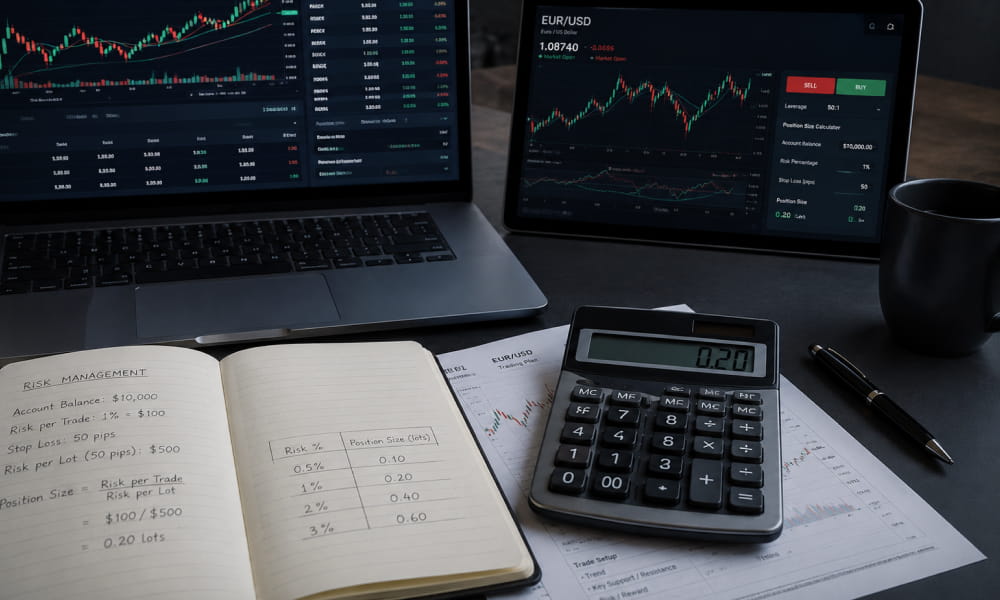
Ukuran posisi = (ukuran akun × risiko%) (stop loss dalam pip × nilai pip)
Itu dia. Tiga masukan, satu keluaran. Tidak diperlukan penggeser leverage.
Panduan: Akun $2.000, Risiko 1%
Risiko dalam dolar: $2.000 × 1% = $20
Jarak stop: 20 pips
Nilai pip untuk lot standar (100rb): $10 pada EUR/USD
Ukuran posisi: $20 ÷ (20 × $10) = $20 ± $200 = 0,1 lot (10.000 unit)
Pada 0,1 lot di akun $2.000, Anda menggunakan leverage sekitar 5:1. Anda tidak memilih 5:1, ini adalah risiko 1%, stop 20 pip, dan nilai pip standar. Ubah input apa pun dan leverage pun akan berubah.
Tabel Referensi Cepat
Ukuran Akun Risiko % Stop (pips) Posisi Maks (lot) Leverage Tersirat $500 1% ($5) 20 0,02 ~4:1 $2,000 1% ($20) 20 0,10 ~5:1 $5,000 1% ($50) 30 0.17 ~3.4:1 $10,000 2% ($200) 50 0.40 ~4:1
Leverage sebagai Pemeriksaan Kepatuhan
Setelah Anda mengukur berdasarkan risiko, lihatlah rasio leverage yang dihasilkan. Jika broker Anda menawarkan 30:1 tetapi perdagangan Anda hanya membutuhkan 5:1, Anda baik-baik saja. Jika ukuran berbasis risiko Anda melampaui leverage maksimum broker Anda (misalnya tuntutan matematika 50:1 tetapi batasan Anda adalah 30:1), Anda memiliki dua pilihan: memperlebar stop atau mengurangi persentase risiko. Batas leverage adalah batasan maksimum, bukan target.
Tetapkan pemberhentian Anda, hitung ukuran Anda, lalu verifikasi leverage berada dalam batas broker. Perintah tersebut, yang mengutamakan risiko, yang terakhir leverage, menjaga akun Anda tetap hidup melewati kekalahan beruntun yang dialami setiap trader.
Pengungkapan risiko. Perdagangan valas dan CFD memiliki tingkat risiko yang tinggi dan mungkin tidak cocok untuk setiap investor. Tingginya tingkat leverage yang tersedia dapat merugikan Anda dan juga merugikan Anda. Studi dari ESMA dan FCA secara konsisten menunjukkan bahwa 74–89% pedagang retail mengalami kerugian. Sebelum memutuskan untuk berdagang, pertimbangkan tujuan investasi Anda, tingkat pengalaman, dan selera terhadap risiko, dan jangan pernah berdagang dengan uang yang Anda tidak mampu kehilangannya.
FAQ
Apa itu leverage dalam forex secara sederhana?
Leverage adalah modal pinjaman dari broker yang memungkinkan Anda mengontrol posisi lebih besar dengan deposit lebih kecil. Misalnya, leverage 1:100 berarti Anda dapat mengontrol mata uang senilai $100.000 hanya dengan $1.000 di akun Anda. Ini mengalikan potensi keuntungan dan potensi kerugian dengan faktor yang sama. Anggap saja ini seperti kaca pembesar untuk modal trading Anda, berguna jika digunakan dengan hati-hati, dan berbahaya jika digunakan secara berlebihan.
Apa leverage yang paling aman untuk trader pemula?
Sebagian besar trader berpengalaman merekomendasikan 1:10 atau lebih rendah untuk pemula. Rasio 1:10 berarti pergerakan pasar sebesar 1% mengubah akun Anda sebesar 10%, terlihat nyata namun dapat bertahan. Banyak broker ritel menetapkan default 1:30 atau 1:50, yang dapat menghapus akun kecil setelah beberapa kali mengalami kerugian. Mulailah dari yang rendah, buktikan strategi Anda berhasil, lalu pertimbangkan untuk meningkatkan leverage secara bertahap seiring dengan peningkatan manajemen risiko Anda.
Bisakah Anda kehilangan lebih dari deposit Anda dengan leverage forex?
Di sebagian besar broker yang teregulasi, tidak. Perlindungan saldo negatif memastikan kerugian Anda tidak melebihi ekuitas akun Anda. Namun, tidak semua yurisdiksi mewajibkan hal ini. Di lingkungan yang tidak diatur atau di luar negeri, pasar yang bergerak cepat dapat mendorong saldo Anda di bawah nol, sehingga Anda harus berhutang kepada broker. Selalu periksa status peraturan broker Anda dan konfirmasi apakah perlindungan saldo negatif berlaku untuk jenis akun Anda sebelum melakukan perdagangan dengan leverage.
Apa yang terjadi jika Anda mendapat margin call dan tidak menambahkan dana?
Broker Anda akan secara otomatis menutup posisi terbuka Anda, dimulai dengan perdagangan yang merugi terbesar, hingga tingkat margin Anda kembali di atas ambang batas yang disyaratkan. Proses ini disebut stop-out. Anda kehilangan sisa ekuitas di posisi tersebut. Broker tidak memerlukan izin Anda, likuidasi terjadi secara otomatis. Setelah stop-out, sisa dana tetap ada di akun Anda, namun dalam banyak kasus saldonya mendekati nol.
Apakah leverage 1:3000 legal dan siapa yang menawarkannya?
leverage 1:3000 tidak legal untuk broker yang diatur oleh otoritas besar seperti FCA (Inggris Raya), CySEC (UE), ASIC (Australia), atau CFTC (AS). Yurisdiksi tersebut membatasi leverage pada 1:30 hingga 1:50 untuk klien ritel. Namun, beberapa broker luar negeri yang terdaftar di Vanuatu, Seychelles, atau Kepulauan Virgin Britania Raya menawarkan rasio setinggi 1:3000. Perdagangan pada level ini membawa risiko ekstrem, pergerakan pasar sebesar 0,03% yang merugikan Anda dapat menghapus akun Anda.
Baca selanjutnya